Annual Conference: The Twentieth-Century Cathedral - Saturday, 4 October, 2025 - Abstract 1
Date published:
Introduction: an overview of what drove the creation of new cathedrals in the twentieth century and the common themes between them.
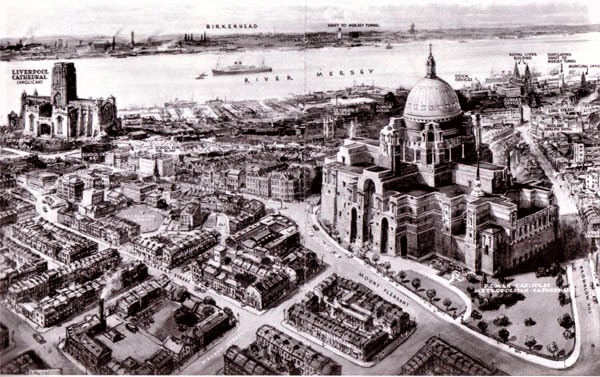
(Picture: impression of the two new cathedrals in Liverpool published in the Illustrated London News,13 October 1934)
The Rev Dr Allan Doig, fellow of Lady Margaret Hall, Oxford; historian of liturgy and church architecture, writes:
"Surprisingly, the twentieth century was an age of new cathedrals in England, in both the Anglican and Roman Catholic Churches. At the forefront of this remarkable phenomenon are the Anglican Cathedrals in Liverpool and Coventry, and the Roman Catholic Cathedrals of Liverpool and Bristol. Each of these is in its own way a radical architectural response to a practical theological problem, or perhaps more accurately, a set of practical, pastoral and theological problems, but if ‘form follows function’ in any meaningful sense at all, how are we to deal with such different buildings within the single category of ‘cathedral’?
"Dare I suggest that the Ecclesiological Society is uniquely and specifically equipped to analyse and assess these buildings as architectural responses in their own terms and their own times and in their continuing ministries? ‘Ecclesiology’ has two distinct meanings, depending who you are talking to. In the printed version of the Compact Oxford English Dictionary, the definition was specifically shaped by this Society as the ‘science of church building and decoration’, with the reference being to A Handbook of English Ecclesiology, published by the Society in 1847. If, on the other hand, I am talking to a colleague who is a theologian, they will be thinking about another more contemporary Handbook of Ecclesiology published by Oxford in 2018 which offers a broader definition as ‘the study of the self-understanding of the Church through the centuries’. I would contend that the two definitions both provide effective tools for analysing and understanding the other: that is to say, the study of Churches as institutions can illuminate the study of churches as buildings, and vice versa, posing the question, how did the understanding of what it is to be a Church in that place, at that time, in that urban context, in that Communion result in that architectural form?
"What was it about Scott’s competition entry for Liverpool Cathedral that held up a mirror to the Church (or at least the committee); or similarly at Coventry; or at the Metropolitan Cathedral what was it that caused such a profound shift in direction between the Lutyens and the Gibberd designs? Over the passage of time into the new millennium have these buildings allowed the Churches to continue their authentic ministries in changed circumstances or left them shackled to a period piece? These are some of the questions to be broached, but their resolution would take all day, and more."
Related pages