Annual Conference: The Twentieth-Century Cathedral - Saturday, 4 October, 2025 - Abstract 3
Date published:
Roman Catholic cathedrals in context: exploring the variety within this group of cathedrals and their characteristics
Andrew Derrick, Vice Chairman of the Society and architectural consultant, who has worked with a number of these cathedrals
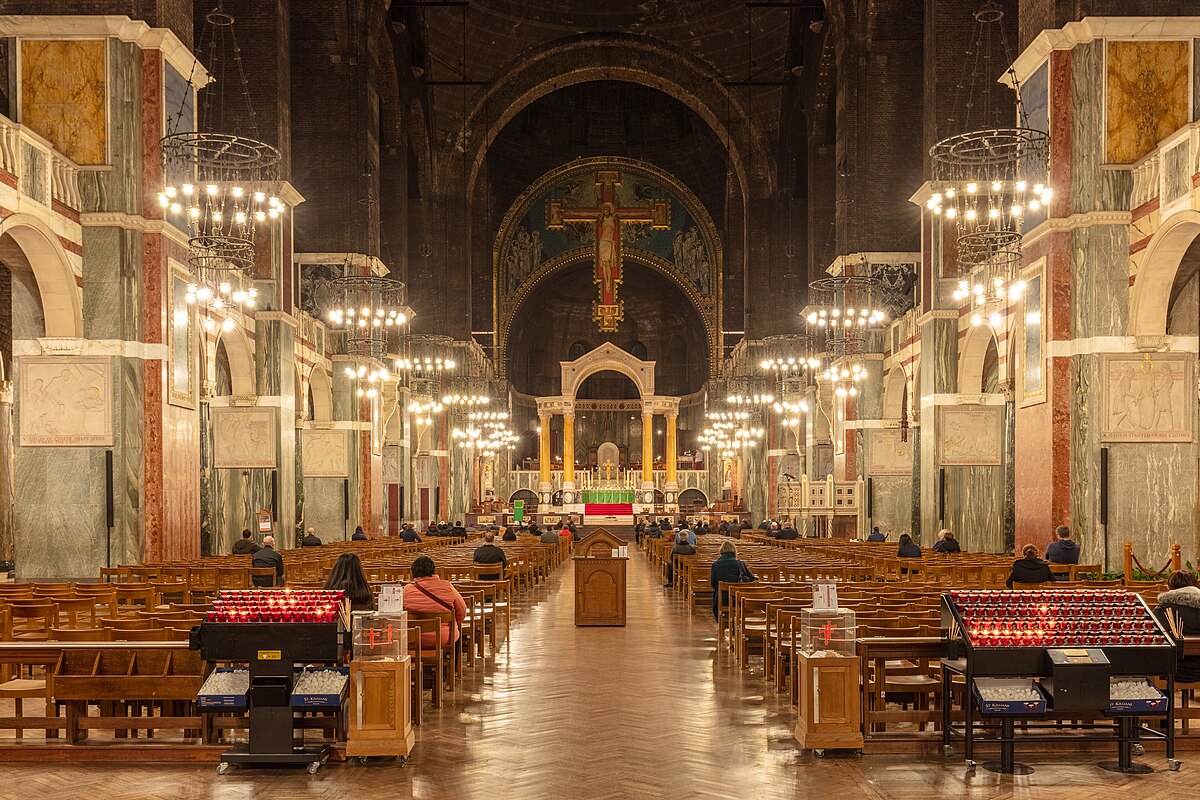
(Picture: Westminster Cathedral)
For most of the twentieth century, the Catholic Church in England and Wales was in expansionist mode, with a huge programme of church building. This included new or enlarged Cathedrals, either to serve newly established dioceses or to provide long-awaited permanent buildings in existing ones. Five Cathedrals were built, and three more or less rebuilt (one of them twice). Perhaps the finest of them all was destined never to rise above crypt level. In the late 1960s and 1970s cathedrals underwent reordering, sometimes drastic, to meet the demands of a new liturgy and a new ecclesiology, while recent decades have seen attempts at mitigation of some of the worst excesses, a ‘reordering of the reordering’. Some of the major building projects (Liverpool, Clifton) are well known; others (Northampton, Middlesbrough) less so. Each is a product of its time in terms of liturgical outlook, architecture and aesthetics, economics and the perceived place of Catholicism in British culture. This paper will provide a tour d’horizon, looking at the main drivers behind cathedral building, design and reordering in the twentieth century, and considering how this legacy is to be managed as the expansionism which gave rise to their construction has given way to a mood of retrenchment if not decline.
Related pages