Stained Glass at St Mary le Bow London - The Ecclesiological Society
Wren Watching Tour, Wednesday 15 April 2026
Date published:
Despite the unpromising weather, the tour was well attended. We met Jill Finch and Alexandra Epps, our guides, outside the Guildhall in full view of the first church on the tour, St Lawrence Jewry. As Jill pointed out, development in the City is constantly encroaching on the space surrounding the churches in the area. However, thanks to its status as the official church of the Corporation of the City of London, St Lawrence Jewry is remarkable as it can be readily viewed from all sides.
At this point, we donned headsets and headphones, allowing for better comprehension of the guides during the tour, and Jill then gave us a general introduction to the City churches, notably those designed by Sir Christopher Wren. Once inside the building, it became apparent that the refined exterior of St Lawrence Jewry was echoed by its elegant, light-filled interior. As we sat on the pews in the beautifully tranquil and airy nave, Jill described the history of the church and its association with Wren. Alex then gave an introduction to the glass by Christopher Webb (1959-1960) and offered a careful examination of the details of each window, which provided a much better understanding of the church, and its place in the history and political life of the City more broadly. As we left, we stopped in the porch to admire the portrait window of Wren and his two master craftsmen, Grinling Gibbons and Edward Strong.
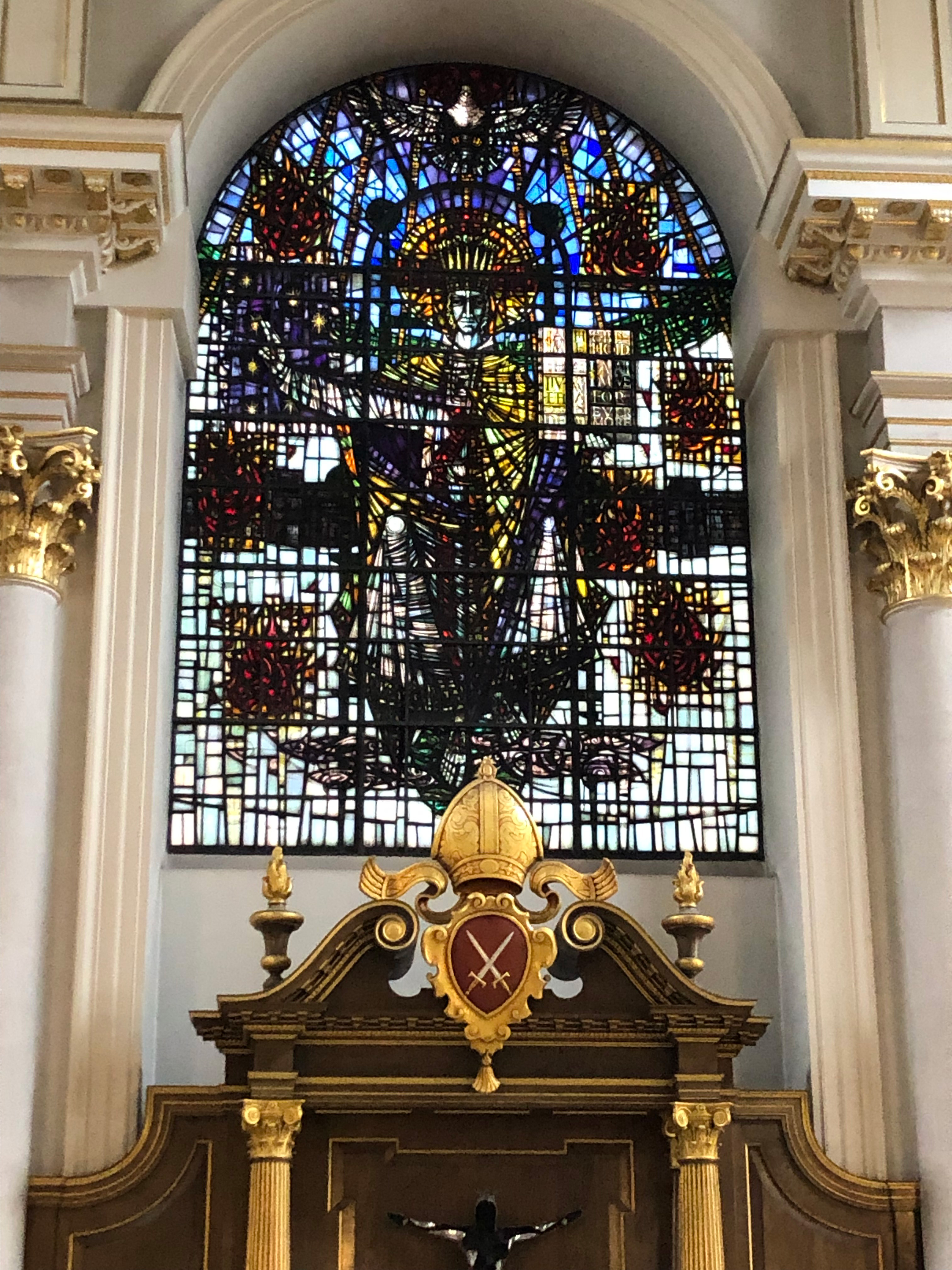
St Mary le Bow, the second of the Wren churches on the tour, was only a few minutes’ walk away. Jill supplied extra information about the places we passed, which helped put the churches in a context. On entering the nave of St Mary le Bow, via the tower and vestibule, your attention is immediately drawn to the east wall with the altar and handsome wooden reredos set below a series of large stained glass windows, designed by John Hayward (1964) - pictured. As Alex discussed, the glass forms a striking contrast to that in St Lawrence Jewry in its design and effect. Although the design is arresting, bulky construction outside the east wall now prevents light flooding through and therefore diminishes its impact somewhat. Much of its beauty lies in the unusual use of mosaic-like shards of coloured glass, representing Christ in Majesty, St Paul, the Virgin Mary cradling a representation of the church in her arms, and, in the uppermost window above the altar, the Holy Spirit.
St Mary Aldermary provided the final Wren church on the tour. Entering through the west doors, the space bustled with hungry city workers making the most of the café set up in that end of the building. However, we managed to find seats in the pews at the – much calmer – eastern end of the nave, where we had an excellent view of the fine plaster fan-vaults, as well as much of the glass by Lawrence Lee and John Crawford (1952 and 1955).
On exiting the church, our knowledgeable, experienced and enthusiastic guides concluded a very successful tour. A few of us went on to have lunch together and an enjoyable chat about the places we had visited.